

CPTCexam
Donor Management: Testing & Suitability - CPTC Study Guide (2026 Edition)
Donor Management: Testing & Suitability - CPTC Study Guide (2026 Edition)
Couldn't load pickup availability
This guide is designed to help you master one of the most detail-heavy and policy-driven areas of the CPTC exam: Donor Testing and Suitability which falls under the Donor Management section.
This guide teaches you what must be tested, verified, timed, and reported before those organs move. Almost every rule here comes from the Organ Procurement and Transplantation Network (OPTN) policies and the U.S. Public Health Service (PHS) infectious-disease guidance, so the guide teaches the standard national requirements rather than any one Organ Procurement Organization's (OPO's) internal practice — which is exactly how the CPTC exam is written.
Determining whether an organ is suitable is not based on intuition or a single laboratory result. It requires a precise sequence of blood typing, independent verification, specimen-quality assessment, infectious-disease screening, organ-specific testing, risk communication, documentation, and reporting before an organ can be safely offered or released.
CPTC Study Guide: Donor Testing & Suitability
Testing to Determine Organ Suitability accounts for 19% of the scored CPTC exam, or approximately 28 of the 150 scored questions on the current ABTC blueprint. This guide is built to the July 1, 2026 CPTC test specifications and is designed to pair directly with the 50-question Testing & Suitability practice set.
This guide helps candidates think like an Organ Procurement Coordinator: confirming that required information is complete, verifying blood type before allocation, assessing whether specimens are reliable, coordinating infectious-disease testing, recognizing critical timing windows, preparing complete organ-offer information, and communicating risks that may affect recipient safety.
Why This Guide Is Different
The CPTC exam does not simply test whether you recognize common donor laboratory tests. It tests whether you know which tests are required, when they must be obtained, how results must be verified, what must accompany each organ offer, and what action is required when information is missing, conflicting, delayed, or abnormal.
Blueprint-Aligned: Built around the current ABTC Donor Management and Optimization domain, Task 1: performing or coordinating the testing required to determine organ suitability.
OPTN Policy-Focused: Covers national requirements for deceased-donor blood typing, ABO verification, subtyping, sample quality, hemodilution, retained specimens, general risk assessment, infectious-disease testing, organ-specific offer information, post-procurement reporting, and conflicts of interest.
CDC/PHS-Aligned Learning: Reviews universal HIV, HBV, and HCV NAT, current donor-risk criteria, the 30-day behavioral-risk window, required recipient follow-up testing, and the transition away from the former “increased-risk donor” label.
The “Exam Lens”: This guide helps you identify the safest and most policy-consistent answer—not simply the answer that seems clinically reasonable. You will learn to ask:
- What must be verified before the match run?
- What must be completed before the offer?
- What must be resulted before organ release or implantation?
- Is the test always required, required only if performed, or a reasonable effort?
- Does a conflicting result require re-verification, re-execution of the match run, or immediate reporting?
These distinctions are central to this task and frequently determine the correct CPTC answer.
What’s Inside
12 Numbered Study Sections: Organized in the natural sequence of the donor-suitability workup—from blood-type determination and sample assessment through infectious-disease screening, organ-specific offers, result reporting, and ethical role boundaries.
The Suitability Mandate and the Coordinator’s Role: Explains why suitability is a chain of required verifications and why the OPC serves as the custodian of the information needed before the match run, organ offer, and organ release.
Donor Blood Typing and ABO Verification: Covers the OPTN “Rule of Twos”—two independently collected blood samples, two separate collection occasions, and verification and reporting by two qualified professionals.
ABO Discrepancies and Match-Run Re-Execution: Teaches candidates what to do when ABO results conflict, how accelerated cases differ, and why a changed final blood type requires the match run to be re-executed.
ABO Subtyping: Reviews when A and AB subtyping is required or optional, how a non-A1 result must be confirmed, and why conflicting or indeterminate subtype results must not be reported for allocation.
Hemodilution and Specimen Quality: Explains why a qualified non-hemodiluted specimen is preferred, when a hemodiluted sample may be used, how the dilution must be calculated and documented, and what must be disclosed to accepting transplant programs.
Retained Donor Specimens: Covers specimen timing, serology and NAT suitability, and the requirement to retain donor blood specimens for at least 10 years after transplantation.
General Donor Risk Assessment: Reviews the required OPTN baseline data for deceased donors, including arterial blood gas, ABO, chest X-ray, CBC, electrolytes, glucose, and urinalysis within the required time window.
Required Infectious-Disease Testing: Includes universal HIV, HBV, and HCV serology and NAT, CMV, EBV, syphilis, Toxoplasma, Strongyloides, lung-donor SARS-CoV-2 testing, seasonal West Nile virus NAT, and Chagas disease screening and confirmation.
PHS Risk Criteria and Recipient Follow-Up: Covers current behavioral and medical risk criteria, unknown donor history, the 30-day assessment period, and universal post-transplant HIV, HBV, and HCV NAT for recipients.
Kidney Suitability and Biopsy Criteria: Reviews kidney-biopsy reasonable-effort triggers, age-based criteria, the age 50–59 “two-of-three” rule, KDPI, anuria, dialysis, diabetes, required HLA information, laterality, anatomy, perfusion data, and documentation when a biopsy cannot be performed.
Liver and Heart Offer Requirements: Clarifies the required 12-hour liver laboratory window, when HLA must be supplied, required heart echocardiography, ABG and ventilator information, and which cardiac data are reported only if available.
Lung Suitability: Covers challenge-gas settings and timing, PEEP, FiO₂, tidal volume, recruitment-maneuver waiting periods, chest X-ray timing, sputum Gram stain, laterality, bronchoscopy, chest CT, and pulmonary-hypertension screening.
Pancreas Suitability: Reviews required family history, HLA information, insulin protocol, amylase and lipase—and the distinction that hemoglobin A1c is reported if performed.
Post-Procurement Result Reporting: Explains how positive cultures and other significant results must be communicated to transplant-program Patient Safety Contacts as soon as possible and no later than 24 hours after receipt.
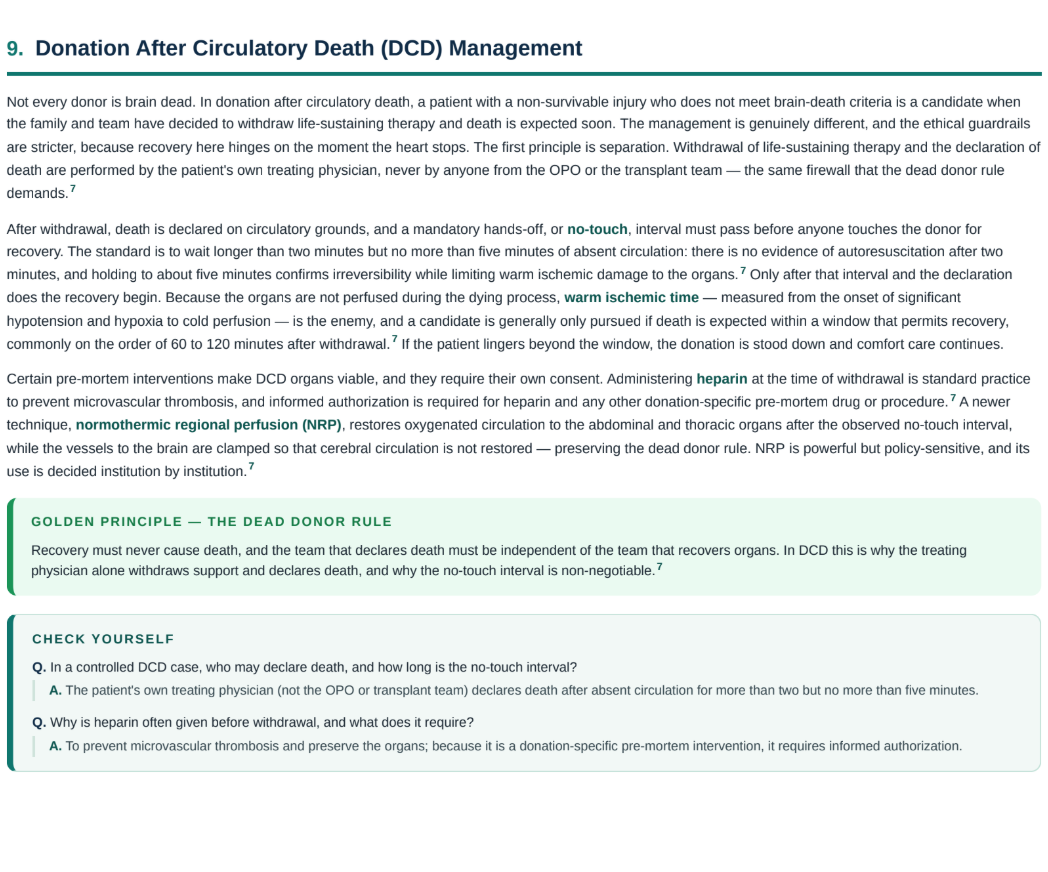
Conflicts of Interest and Separation of Roles: Reinforces that the clinician who declares death must not perform the organ recovery or transplantation.
Visual Quick References
Blood Type to Match-Run Eligibility: A step-by-step workflow follows blood samples from collection through verification, discrepancy resolution, subtyping, match-run eligibility, and re-execution when the final ABO changes.
Required Offer Information by Organ: A master comparison table separates each kidney, liver, heart, lung, and pancreas requirement into three high-yield categories:
- Always required
- Required if performed or requested
- Reasonable effort with documentation
This is one of the most important distinctions in the guide and a frequent source of CPTC exam questions.
Numbers and Timing to Memorize
Donor Testing and Suitability questions depend heavily on exact timeframes and thresholds. This guide consolidates the values candidates are most likely to encounter, including:
- Two blood samples collected on separate occasions
- Two qualified professionals for ABO reporting and verification
- 96-hour HIV, HBV, and HCV specimen window
- 24-hour urinalysis window before cross-clamp
- 24-hour retained-specimen collection window before procurement
- Minimum 10-year specimen-retention period
- July 1–October 31 West Nile virus testing window
- 72-hour Chagas confirmation requirement
- 28–56-day recipient post-transplant NAT window
- 12-hour liver laboratory window
- Four-hour lung challenge-gas window
- Three-hour lung chest X-ray window
- 30-minute wait after a recruitment maneuver
- 24-hour post-procurement positive-result reporting deadline
The guide also separates the three different 24-hour rules so candidates do not confuse their purpose or endpoint.
High-Yield Mnemonics and Exam Alerts
Memorable frameworks help candidates retain the most testable rules:
The Rule of Twos: Two samples, two separate occasions, and two qualified professionals.
GGF-CESU: Gas, Group, Film, Count, Electrolytes, Sugar, and Urine—the required general risk-assessment baseline.
Verify → Offer → Release: Complete the information required for each stage before allowing the donation process to move forward.
Required vs. If Performed vs. Reasonable Effort: A framework for distinguishing mandatory offer information from conditional reporting and documented attempts.
Master Suitability and Testing Checklist
A comprehensive checklist connects all major responsibilities:
- Blood typing and independent verification
- ABO subtyping and discrepancy management
- Hemodilution assessment and disclosure
- Retained specimen collection and storage
- General donor risk assessment
- Universal and targeted infectious-disease testing
- PHS risk assessment and recipient follow-up
- Organ-specific offer requirements
- Positive post-procurement result reporting
- Separation of death determination and organ recovery roles
Companion Practice Strategy
This guide is designed to pair directly with the 50 Donor Testing & Suitability CPTC Practice Questions and Rationales. Every question concept is taught in the guide.
Learn the policy or testing rule in the study guide, apply it to a realistic exam scenario, review the rationale, and return to the corresponding section after each missed question. This approach helps turn isolated facts into a repeatable decision-making process.
Includes
Donor Testing & Suitability CPTC Study Guide — Part 1
The Suitability Mandate and Coordinator’s Role
Donor Blood Typing and ABO Verification
ABO Discrepancies and Accelerated Cases
ABO Subtyping
Hemodilution and Sample Quality
Retained Donor Specimens
General Donor Risk Assessment
Required Infectious-Disease Testing
PHS Risk Criteria and Recipient Follow-Up
Kidney Suitability and Biopsy Criteria
Liver and Heart Offer Requirements
Lung Suitability and Challenge-Gas Requirements
Pancreas Suitability
Post-Procurement Result Reporting
Conflicts of Interest and Role Separation
Blood Type-to-Match-Run Workflow
Organ-Specific Offer Reference Table
Numbers and Timing to Memorize
Mnemonics, Exam Alerts, and Golden Rules
Master Suitability and Testing Checklist
Footnoted OPTN and CDC/PHS Sources
Don’t just memorize donor tests—learn what must be verified before you proceed.
This digital study guide transforms dense OPTN policy, infectious-disease requirements, timing windows, and organ-specific offer rules into a clear, student-friendly system. It is designed to help OPCs understand what must be tested, when the information is due, how it must be verified, who must receive it, and what action protects the recipient when results are incomplete or conflicting.
Exam Tip: When in doubt, choose the answer that completes and verifies the required information before proceeding, communicates donor risk clearly, protects the integrity of the match run, and prevents an organ from being released on incomplete or unconfirmed data.
Share