This guide is designed to help you master one of the most heavily tested areas of the CPTC exam: Donor Management & Optimization — Optimizing Organ Function. In the world of organ procurement, donor management is not passive monitoring. It is an active, time-sensitive clinical process that protects organ viability, improves utilization, and supports recipient safety through targeted interventions.
CPTC Exam Practice Questions: Donor Management & Optimization — Optimizing Organ Function
Donor Management and Optimization accounts for 37% of the CPTC exam, making it the largest single domain on the current ABTC blueprint. This Part 2 question set focuses specifically on Task 2: optimizing organ function through clinical interventions to maximize utilization and recipient safety.
This guide moves beyond memorization and helps candidates think like an Organ Procurement Coordinator: recognizing reversible donor instability, choosing appropriate interventions, understanding how abnormal labs affect organ systems, and supporting hemodynamic and pulmonary stability during active donor management.
Why This Guide is Different
The CPTC exam does not just test whether you know donor management goals exist. It tests whether you understand what to do when the donor becomes unstable, which abnormalities are correctable, how interventions affect organ function, and how to protect recipient safety while preserving the opportunity for donation.
Blueprint-Aligned: Built directly around the ABTC CPTC Donor Management and Optimization domain, with focused practice on Task 2: optimizing organ function through clinical interventions.
Clinically Focused Practice: Covers donor hemodynamic instability, diabetes insipidus, hypernatremia, electrolyte correction, glucose management, vasopressors, hormone resuscitation, lung-protective ventilation, bronchoscopy, recruitment maneuvers, chest tube placement, dialysis, temperature management, infection treatment, and abnormal anatomical findings.
The “Exam Lens”: These questions are designed to help you recognize the safest, most clinically appropriate answer — not just the most familiar one. You will practice spotting common traps such as ignoring diabetes insipidus, delaying correction of severe electrolyte abnormalities, using injurious ventilator settings, overloading a potential lung donor with fluid, or failing to reassess organ function after donor optimization.
What’s Inside
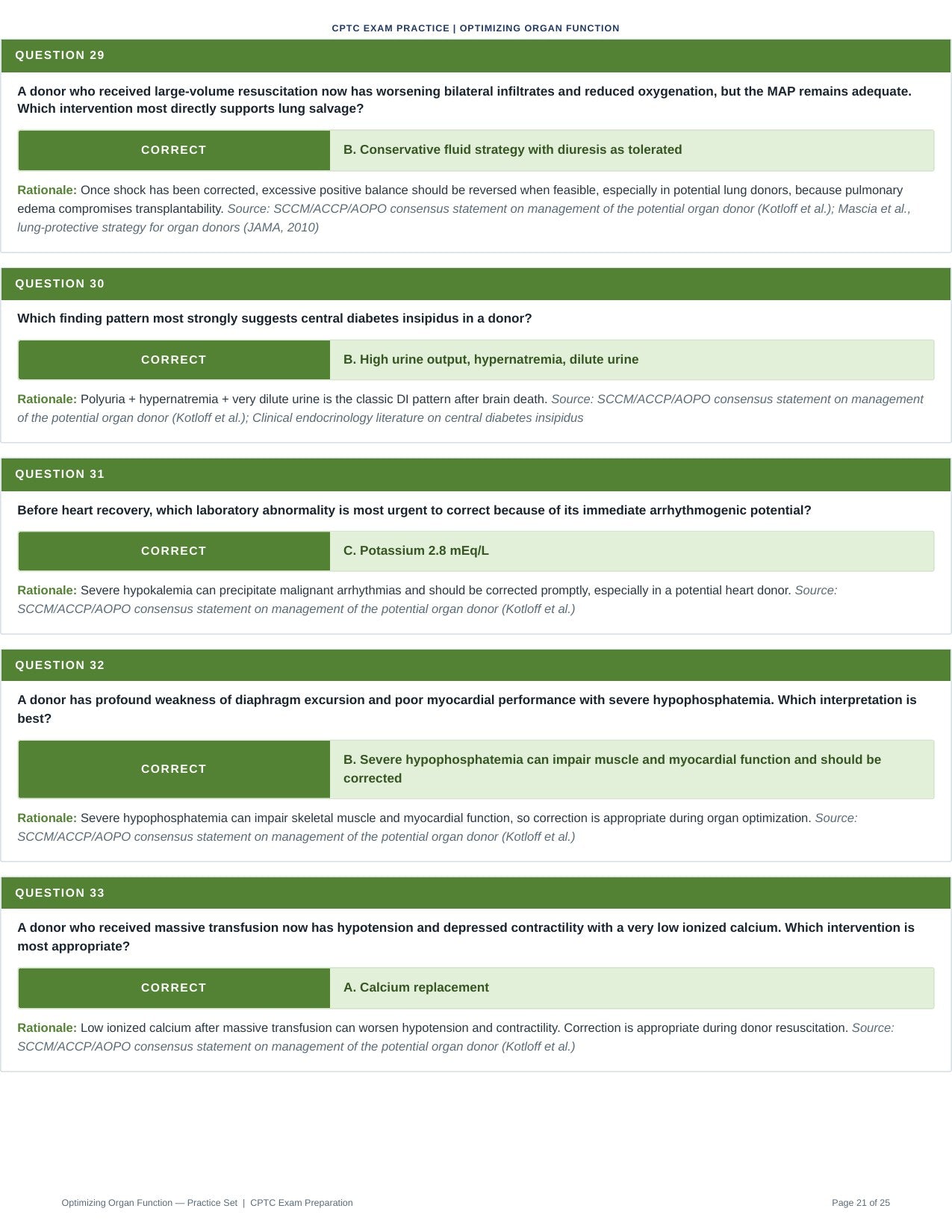
50 Full-Length CPTC Practice Questions: Scenario-based, multiple-choice questions modeled after the style and decision-making level of the real CPTC exam.
Detailed Rationales for Every Answer: Each question explains why the correct answer is right and why the other options are unsafe, incomplete, outdated, or not the best clinical choice.
Optimizing Organ Function Focus Areas: Includes donor shock, vasopressor selection, vasopressin and desmopressin use, central diabetes insipidus, hypernatremia correction, glucose control, hypothermia, electrolyte replacement, fluid balance, pulmonary edema, lung-protective ventilation, bronchoscopy, atelectasis, recruitment, pneumothorax management, cardiac stunning, repeat echocardiography, infection treatment, suspicious skin lesions, track marks, steatosis, dialysis, and integrated donor management decisions.
Source-Based Learning: Each rationale includes a source reference and external link so you can verify the answer and study directly from authoritative donor management, transplant, and critical care guidance.
Every answer and rationale in this question set is source-checked against authoritative organ donation and transplant references, including HRSA/Organdonor.gov, the Revised Uniform Anatomical Gift Act, CDC/USPHS donor risk guidelines, American Academy of Neurology brain death guidance, and UNOS/OPTN policies.
Includes
50 Donor Management & Optimization — Optimizing Organ Function CPTC Practice Questions/Rationales
Don’t just memorize donor management goals — learn how to apply them.
This download includes 50 scenario-based, multiple-choice CPTC practice questions focused on optimizing donor organ function through clinical interventions. Each question includes a detailed rationale to help you understand the clinical reasoning behind the correct answer and build the judgment needed for real-world donor management.
Exam Tip
When in doubt, choose the answer that corrects the reversible problem, supports hemodynamic or pulmonary stability, protects recipient safety, and keeps the donation process moving in a clinically sound and policy-compliant way.
This is not official ABTC content and does not reproduce ABTC questions. It is an independently written, evidence-based study product. For legal hierarchy questions, I used the Revised Uniform Anatomical Gift Act model hierarchy; actual OPO practice must still follow the applicable state law and OPO/hospital policy.