This guide is designed to help you master one of the most important and commonly misunderstood areas of the CPTC exam: Donor Identification & Referral.
In the world of organ procurement, donor referral is not just a phone call. It is a time-sensitive clinical, regulatory, and ethical process that determines whether a potential donor is recognized early, referred appropriately, evaluated correctly, and managed in a way that protects donation opportunity, family rights, hospital compliance, and recipient safety.
CPTC Smart Practice Questions: Donor Identification & Referral
Donor identification and referral questions test whether you understand how organ donation begins at the bedside: recognizing potential donor triggers, knowing when referral is required, understanding who must be contacted, and applying the correct regulatory pathway before donation conversations or clinical decisions move forward.
This 2026 question set focuses specifically on the real-world decisions Organ Procurement Coordinators and hospital teams must make when a patient meets clinical triggers for referral, when neurologic injury is progressing, when brain death or DCD pathways may apply, or when authorization, documentation, and OPO involvement must be handled correctly.
This guide moves beyond memorization and helps candidates think like an Organ Procurement Coordinator: identifying referral triggers, recognizing imminent death criteria, applying CMS Conditions of Participation, understanding authorization pathways, and choosing the safest, most policy-consistent action when a case is incomplete, urgent, or clinically complex.
Why This Guide is Different
The CPTC exam does not simply test whether you know that hospitals are required to call the OPO. It tests whether you understand when referral must occur, what information matters, how authorization works, what the coordinator must do next, and how to avoid common exam traps involving delayed referral, inappropriate family approach, misunderstanding DCD versus brain death, or failure to follow legal and regulatory requirements.
Blueprint-Aligned: Built around exam-relevant donor identification, referral, authorization, and regulatory decision-making.
Policy-Driven Practice: Covers timely referral requirements, imminent neurological death criteria, brain death versus DCD pathways, first-person authorization, UAGA hierarchy, administrative authorization, HIPAA exceptions for OPOs, medically complex donors, expanded donor utilization, and common compliance issues.
The “Exam Lens”: These questions are designed to help you recognize the safest, most current, and most policy-consistent answer — not just the answer that sounds familiar. You will practice spotting common traps such as late referral, approaching a family before OPO involvement, confusing donor registration with next-of-kin authorization, misunderstanding John Doe cases, or choosing outdated donation practices.
What’s Inside
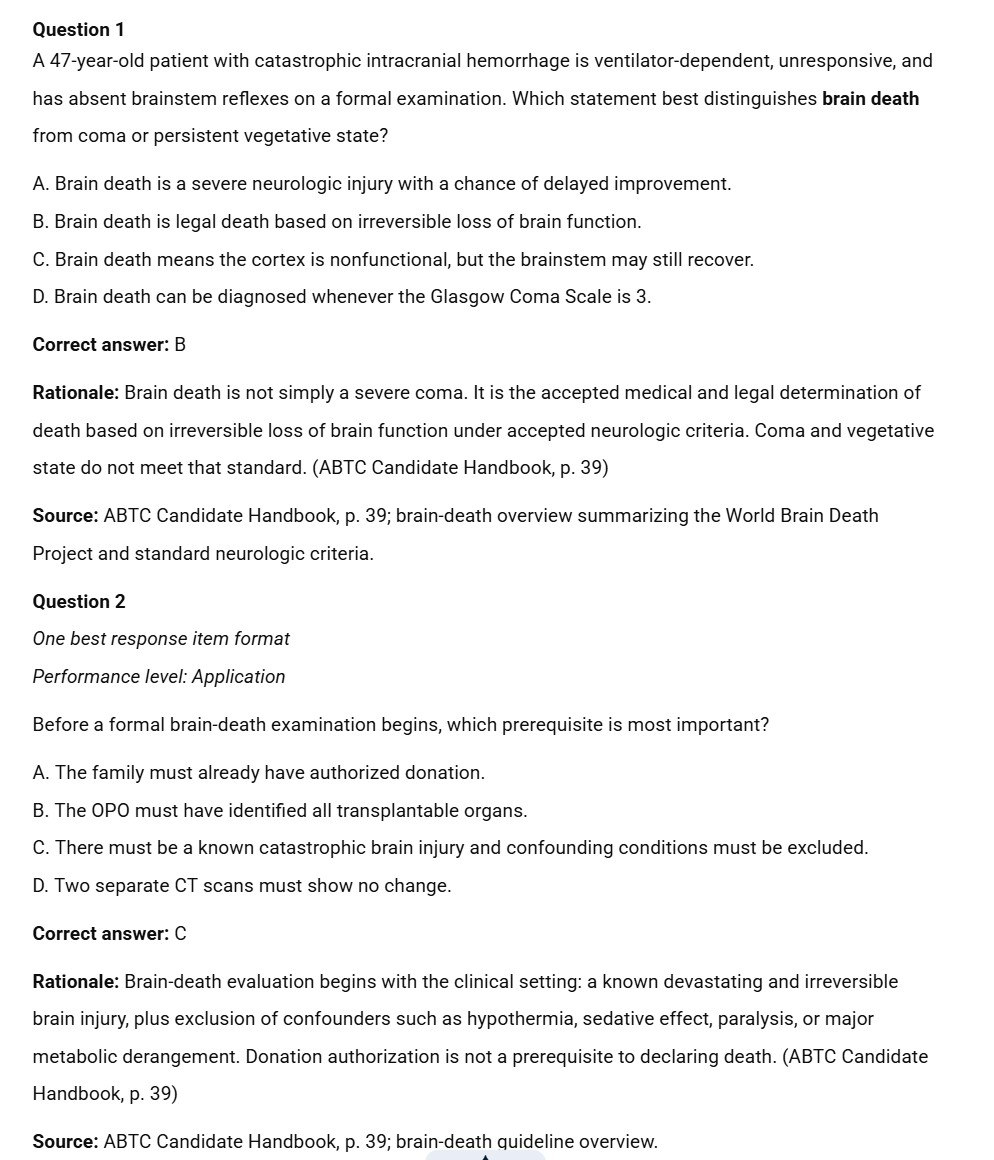
50 Full-Length CPTC Practice Questions: Scenario-based, multiple-choice questions modeled after the style and decision-making level of the real CPTC exam.
Detailed Rationales for Every Answer: Each question explains why the correct answer is right and why the other options are unsafe, incomplete, outdated, or not policy-based.
Donor Identification & Referral Focus Areas: Includes timely referral, imminent death criteria, ventilated patients with devastating neurologic injury, CMS referral expectations, OPO notification, donation after circulatory death pathways, brain death considerations, first-person authorization, UAGA hierarchy, administrative authorization, HIPAA exceptions, family communication boundaries, regulatory compliance, and common CPTC exam misconceptions.
Source-Based Learning: Each rationale is designed to connect the question back to authoritative clinical, regulatory, or policy-based guidance so you can study the reasoning behind the answer — not just memorize a fact.
Includes: 50 Donor Identification & Referral CPTC Practice Questions with Detailed Rationales
Every answer and rationale in this question set is source-checked against authoritative organ donation and transplant references, including HRSA/Organdonor.gov, the Revised Uniform Anatomical Gift Act, CDC/USPHS donor risk guidelines, American Academy of Neurology brain death guidance, and UNOS/OPTN policies.
Don’t just memorize referral requirements — learn how to apply them.
This instant download includes 50 scenario-based, multiple-choice CPTC practice questions focused on donor identification, referral, authorization, and regulatory compliance. Each question includes a detailed rationale to help you understand the clinical, legal, and ethical reasoning behind the correct answer.
Exam Tip: When in doubt, choose the answer that protects the donation opportunity, follows required referral and authorization pathways, preserves regulatory compliance, and involves the OPO before moving forward.
This is not official ABTC content and does not reproduce ABTC questions. It is an independently written, evidence-based study product. For legal hierarchy questions, I used the Revised Uniform Anatomical Gift Act model hierarchy; actual OPO practice must still follow the applicable state law and OPO/hospital policy.